agecheck
Log in Get started
Glossary

Age verification
terminology explained.

Over 100 terms covering identity verification, AI biometrics, compliance regulations, privacy architecture, and industry-specific age gating everything your team needs to speak the language of digital trust.

Core Concepts

The foundational terms
every team should know.

Age Verification

The process of confirming that a user meets a minimum age threshold before granting access to age-restricted content, products, or services. Methods range from self-consent to biometric identity proofing.

Age Gate

A barrier placed at the entry point of a website or application that prevents access until a user completes an age verification step. Can be a simple checkbox, a face scan, or a full document check depending on regulatory requirements.

Identity Verification

A broader process that confirms a user is who they claim to be, typically combining document scanning with biometric matching. Age verification is a subset of identity verification focused specifically on date of birth.

KYC (Know Your Customer)

A mandatory financial regulatory process requiring businesses to identify and verify their clients. In the digital era it encompasses eKYC electronic Know Your Customer which automates CIP (Customer Identification Program) using AI-powered document and biometric checks.

AML (Anti-Money Laundering)

A framework of laws, regulations, and procedures designed to prevent criminals from disguising illegally obtained funds as legitimate income. AML goes beyond identity verification to monitor transaction behavior and flag anomalies using risk scoring models.

Age Check

A general term for any mechanism used to confirm a user's age from a date-of-birth entry form to a full AI-powered biometric scan. In regulatory contexts, "age check" is often used interchangeably with "age assurance," though assurance implies a higher standard of certainty.

ID Verification

The process of authenticating a government-issued identity document passport, driving licence, or national ID card. Modern ID verification uses AI to extract data fields, detect tampering indicators, and score document authenticity from 0 to 100%.

Bio-Verification

Verification that uses biological characteristics facial features, fingerprints, or iris patterns as proof of identity or age. In the age assurance context, bio-verification most commonly refers to face-based age estimation combined with liveness detection.

SaaS Compliance

The delivery of compliance tooling including age verification as a cloud-based subscription service. SaaS compliance eliminates the need for businesses to build and maintain their own verification infrastructure, offloading regulatory risk to a specialized provider.

Age Assurance Technology

The technical term preferred by regulators notably Ofcom and the ICO in the UK over the more commercial "age verification." Age assurance encompasses the full spectrum of methods that give a platform reasonable confidence that a user is above a specified age threshold.

Online Age Wall

A colloquial term used by website owners and content publishers to describe any digital barrier that restricts access based on age. The term has gained traction in policy discussions around protecting minors from adult content on the open web.

Identity Proofing

The process of gathering, validating, and verifying information about a person to establish that they are who they claim to be. NIST SP 800-63A defines three levels of assurance: IAL1 (self-asserted), IAL2 (remote proofing), and IAL3 (in-person or supervised remote). Applied to age-restricted goods, identity proofing confirms both identity and eligibility.
AI & Biometrics

The technology behind
modern age estimation.

Face AI

An AI-powered module that uses computer vision and deep neural networks to analyze a facial image. In age verification, Face AI estimates age from biometric facial features without requiring any document, returning a probabilistic result against a configured age threshold.

Facial Age Estimation

The use of machine learning models trained on large datasets of labeled facial images to infer an estimated age range from a selfie. Unlike document-based verification, facial age estimation is anonymous it produces a pass/fail decision without capturing or storing the subject's identity.

Liveness Detection

A security layer that distinguishes a live human face from a spoof attempt a photograph, video replay, or 3D mask. Liveness detection is critical to defeating presentation attacks. Measured against ISO/IEC 30107-3, which classifies the strength of Presentation Attack Detection (PAD).

Passive Liveness Detection

Liveness analysis that runs invisibly in the background without requiring the user to perform any action no blinking, head turning, or phrase repetition. Passive liveness analyzes skin micro-texture, specular light reflection, and depth cues, delivering maximum security with zero friction.

Face Matching

A 1:1 biometric comparison that checks whether a live selfie matches the face on a presented identity document. Accuracy is measured by FAR (False Acceptance Rate) and FRR (False Rejection Rate). Verify-AI requires a similarity score above a configurable threshold (typically 90%) for a positive match.

Deepfake Detection

A countermeasure that identifies AI-generated or manipulated video streams attempting to bypass a selfie check. Deepfake-resistant age verification combines passive liveness, frame inconsistency analysis, and behavioral signals to block generative AI fraud attempts in real time.

Biometric Template

A mathematical representation of a person's facial features, expressed as a numerical vector rather than a photograph. Biometric templates cannot be reverse-engineered into a recognizable image, making them less privacy-invasive than storing raw imagery.

Behavioral Biometrics for Age

The analysis of how a user interacts with a device typing cadence, swipe speed, mouse movement patterns as supplementary signals in age estimation. Behavioral biometrics add a passive layer of fraud detection that does not require a camera.

Multi-Spectral Face Analysis

Advanced anti-spoof technology that analyzes facial images across multiple light spectra beyond the visible range. Multi-spectral analysis detects silicone masks and high-quality printed photographs that fool standard RGB cameras.

Low-Latency Face AI

Optimization of the Face AI pipeline to minimize the time between image capture and result delivery. For high-traffic platforms, low-latency processing typically under 1.5 seconds is essential to maintain conversion rates during the age verification step.

AI Liveness Protection

A holistic framework combining passive liveness, deepfake detection, and presentation attack detection (PAD) to protect a verification session from all known biometric fraud vectors. Evaluated against iBeta Level 1 and Level 2 PAD testing standards.

Non-Invasive Age Estimation

Age estimation methods that do not require document upload, biometric storage, or explicit user consent beyond a single-frame selfie capture. Prioritizes user privacy by generating only a pass/fail result, with no PII retained after the session closes.
Document Verification

Reading identity documents
with AI precision.

Document AI

An AI-powered verification module that scans government-issued identity documents, extracts the date of birth using OCR, and scores document authenticity from 0 to 100%. Document AI supports 150+ document types from 56+ countries including passports, driving licences, and national ID cards.

MRZ (Machine Readable Zone)

The two or three-line coded strip at the bottom of passports and travel documents, standardized by ICAO Doc 9303. The MRZ contains name, nationality, date of birth, and document number. Check digits embedded in the MRZ allow instant forgery detection if the visual zone data has been altered.

OCR (Optical Character Recognition)

Technology that converts printed or handwritten text in a document image into machine-readable structured data. In document age verification, OCR extracts the date of birth field from the visual inspection zone (VIZ) and cross-validates it against the MRZ to confirm consistency.

NFC Reading

Near Field Communication technology used to read the biometric chip embedded in e-Passports (ICAO compliant). NFC reading provides a cryptographically signed copy of the document holder's data, offering the highest available assurance that the document has not been tampered with.

Document Authenticity Scoring

An AI-generated confidence score (0–100%) indicating the probability that a scanned document is genuine. The score accounts for font consistency, hologram placement, security feature presence, and MRZ check digit validity. Platforms configure a threshold typically 80% for streaming, 90% for e-commerce, 95% for fintech and gambling.

AI Automated ID Scanning

The end-to-end pipeline that captures a document image via smartphone camera, auto-crops and deskews it, runs OCR and authenticity checks, and returns a structured result all without human review. Processing time is typically under 3 seconds per document.

Digital Document Forensic Analysis

Deep AI inspection of security features in a document image UV-reactive ink patterns, microprint, guilloche backgrounds, and laser perforation patterns. Forensic analysis runs in parallel with OCR to detect sophisticated forgeries that pass basic visual inspection.

Frictionless ID Scanning

A document capture experience optimized to minimize user effort: auto-focus guidance, real-time feedback on glare and distance, and automatic shutter triggering when the document is correctly positioned. Frictionless ID scanning directly reduces verification drop-off rates.

DOB Extraction

The specific sub-task within Document AI of accurately reading the date of birth from a document's visual zone, MRZ, and any barcode or chip present, then cross-validating all three sources. Discrepancies between zones automatically flag the document for review or rejection.
Compliance & Regulation

The legal landscape
your platform must navigate.

GDPR (General Data Protection Regulation)

The EU regulation governing personal data processing. Article 9 classifies biometric data as a "special category" requiring explicit consent or a documented legal basis. GDPR-compliant age verification must minimize data retention and provide a legal basis for any biometric processing performed during the verification step.

COPPA (Children's Online Privacy Protection Act)

A US federal law that prohibits collecting personal data from children under 13 without verifiable parental consent. COPPA compliance software ensures that minors are blocked at the age gate before any data collection occurs, so no under-13 PII ever reaches the platform's infrastructure.

CCPA (California Consumer Privacy Act)

California's privacy law granting consumers the right to know what data is collected about them, the right to delete it, and the right to opt out of its sale. Age verification platforms operating in California must support consumer rights management and prohibit the sale of any verification-related personal data.

UK Online Safety Act

UK legislation requiring platforms that host pornographic or other harmful content to implement "highly effective" age assurance. Ofcom's guidance distinguishes between "age verification" (document or biometric-based, highest tier) and "age estimation" (facial analysis, lower tier). Document-AI meets the highest tier requirements.

AVMS Directive (Audiovisual Media Services)

The EU directive requiring video-on-demand platforms to implement effective age verification for content harmful to minors. Face-AI and Document-AI both meet AVMS requirements for streaming platforms operating across EU member states.

eIDAS (Electronic Identification and Trust Services)

The EU regulation establishing a framework for electronic identification and trust services. eIDAS 2.0 introduces the European Digital Identity Wallet, which allows citizens to share verified credentials including age across member states without re-verifying each time.

Digital Services Act (DSA) Age Requirements

The EU Digital Services Act imposes age verification obligations on Very Large Online Platforms (VLOPs) and Very Large Online Search Engines (VLOSEs). Platforms with over 45 million EU users must implement age assurance to protect minors from age-inappropriate content and targeted advertising.

BIPA (Biometric Information Privacy Act)

An Illinois state law requiring businesses to obtain written consent before collecting biometric identifiers, to publish a retention schedule, and to prohibit the sale of biometric data. BIPA-compliant face analysis involves no biometric storage only a transient in-memory comparison that is discarded immediately after the session.

Age-Appropriate Design Code

The UK ICO's Children's Code requiring that online services likely accessed by under-18s apply the highest privacy settings by default and verify that users are of appropriate age before exposing them to data-intensive features. Compliance requires integrating an age assurance step into the onboarding flow.

K-12 Age Gate Solutions

Verification configurations specifically designed to protect children in the kindergarten-to-grade-12 age range (5–18 years) from age-restricted content. K-12 solutions typically use self-consent or parental consent APIs rather than biometric checks, minimizing data collection in line with COPPA and FERPA.

RegTech for Age Gating

The application of regulatory technology to automate compliance with age restriction laws. RegTech platforms replace manual compliance reviews with algorithmic checks, audit trails, and real-time monitoring reducing the compliance overhead for legal teams in enterprise organizations.
Privacy & Security

Privacy-first architecture.
Zero compromise.

PII-Free Identity Verification

A verification architecture that returns only a pass/fail result never storing names, document numbers, facial images, or any other personally identifiable information after the session ends. PII-free design eliminates data breach liability and simplifies GDPR compliance documentation.

Age Verification Without Storing Biometric Data

A processing model in which biometric data selfies, facial vectors, and document images is used exclusively in memory during a live verification session and deleted the moment the result is returned. No biometric database is created, making it compliant with GDPR Art. 9, BIPA, and CCPA by design.

Ephemeral Processing

A data-handling pattern in which all sensitive inputs biometric images, document scans, and extracted PII exist only in volatile memory for the duration of a verification request. Once the API response is dispatched, all ephemeral data is irrecoverably purged.

HMAC-SHA256 Signing

A cryptographic authentication method used to sign webhook payloads. HMAC-SHA256 allows the receiving server to verify that the webhook was genuinely sent by the verification provider and has not been tampered with in transit, preventing man-in-the-middle injection attacks.

Anti-Replay Protection

A security mechanism that prevents an attacker from reusing a previously captured valid verification response to fraudulently gain access. Implemented via timestamp-bound nonce validation each verification session is single-use and expires within a configurable window.

Zero-Knowledge Proof Age Check

A cryptographic protocol that allows a user to prove they are above a minimum age to a verifier without revealing their actual date of birth or any other personal attribute. ZKP age checks are the emerging standard for privacy-preserving compliance in Web3 and decentralized identity ecosystems.

Synthetic Identity Fraud Prevention

Detection of fraudulent identities created by combining real identity elements (a valid Social Security number) with fabricated data (a false name and date of birth). AI models detect synthetic identities by cross-referencing behavioral patterns, device signals, and document metadata inconsistencies.

Fraud Score

A numerical value (0–100%) generated by AI during each verification session, reflecting the probability that the session represents a genuine user rather than a fraud attempt. The fraud score incorporates liveness confidence, document authenticity, device signals, and IP risk factors.

Anonymized Audit Logs

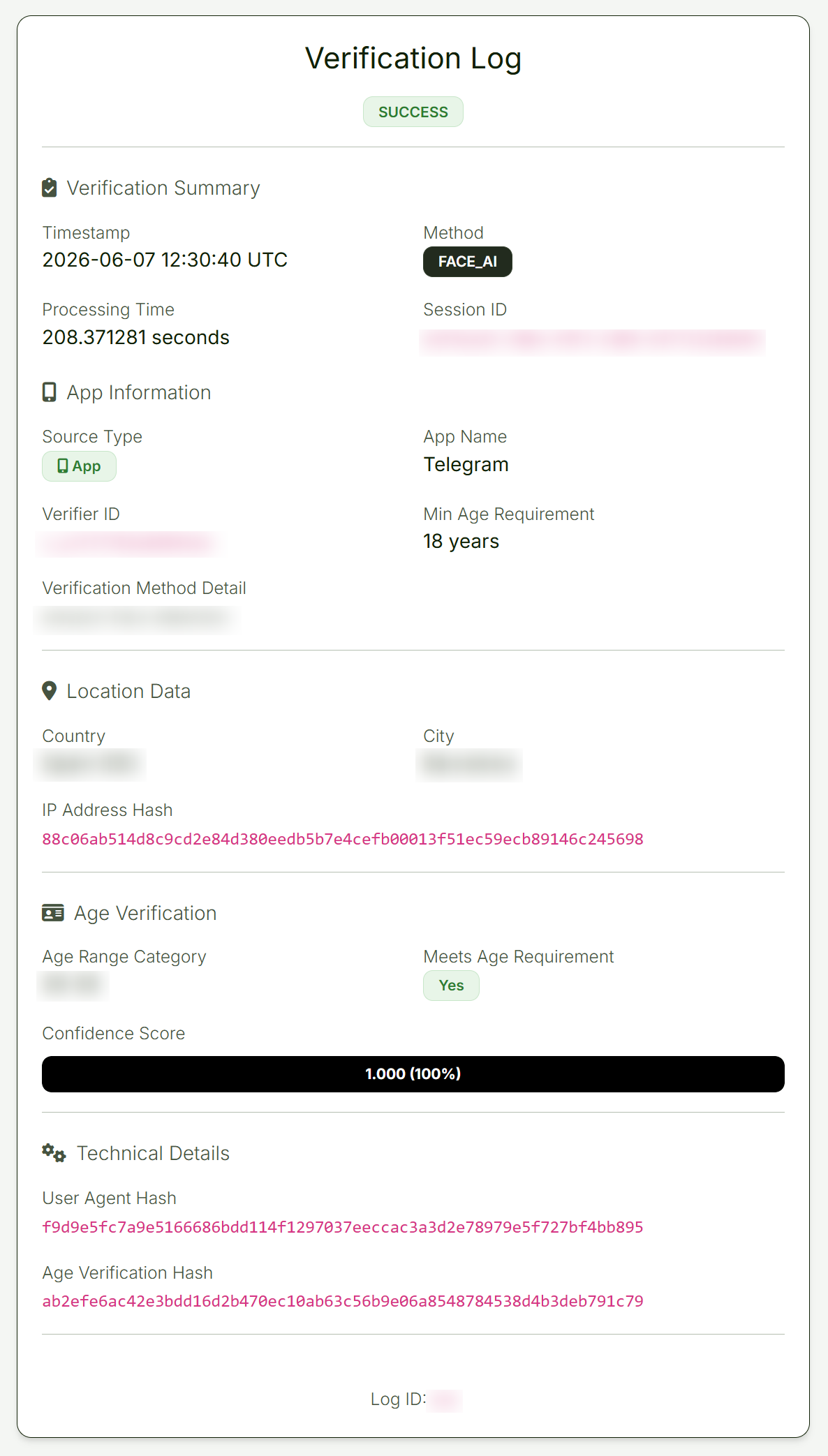
Verification records that document session outcome, method used, fraud score, and timestamp without retaining the PII used to reach that conclusion. Anonymized logs satisfy KYC/AML record-keeping requirements (typically 5 years under 6AMLD) while remaining compliant with data minimization principles.

Rate Limiting

A defense mechanism that restricts the number of verification attempts from a single IP address within a defined time window. Typically set at 3 failed attempts per hour, rate limiting stops bot-driven credential stuffing and distributed fraud attacks before they consume verification quota.

Spoofing-Resistant Age Gate

A verification flow hardened against common spoofing vectors: printed photos, video replays, 3D-printed masks, and AI-generated deepfakes. Spoofing resistance is achieved by combining passive liveness detection, multi-spectral analysis, and behavioral anomaly scoring in a single session.

Hardware-Attested Age Verification

Verification that leverages device-level hardware security modules Apple's Secure Enclave, Android's StrongBox to cryptographically bind a verification result to a specific device. Hardware attestation provides a high-assurance guarantee that the session was conducted on a genuine, uncompromised device.
Integration & API

One integration.
Every platform covered.

Age Verification API

A RESTful API that accepts a verification request, processes the biometric or document check, and returns a structured JSON result containing the outcome, method used, fraud score, and session ID. The API is the core integration surface for developers building age verification into any application.

Age Verification SDK

A lightweight software development kit typically a single JavaScript tag, iOS framework, or Android library that embeds the full verification UI and logic into a host application. An SDK eliminates the need to build camera handling, liveness UX, or result parsing from scratch.

Webhook

An HTTP callback that delivers a verification result to a developer-specified endpoint in real time, the moment a session concludes. HMAC-SHA256 signing on every payload allows the receiving server to authenticate the event before acting on it.

Smart Identity Orchestrator

A platform layer that manages method selection, session lifecycle, result delivery, and fallback logic across multiple verification methods from a single integration point. Orchestration allows compliance teams to switch methods per jurisdiction from a dashboard without any code changes.

External Session Age Verification

A verification model designed for environments without a built-in browser native apps, bots, kiosks, and IoT devices. The host application initiates a session via API, then receives the result via webhook once the user completes verification on a separate browser or mobile device.

QR Handoff Age Verification

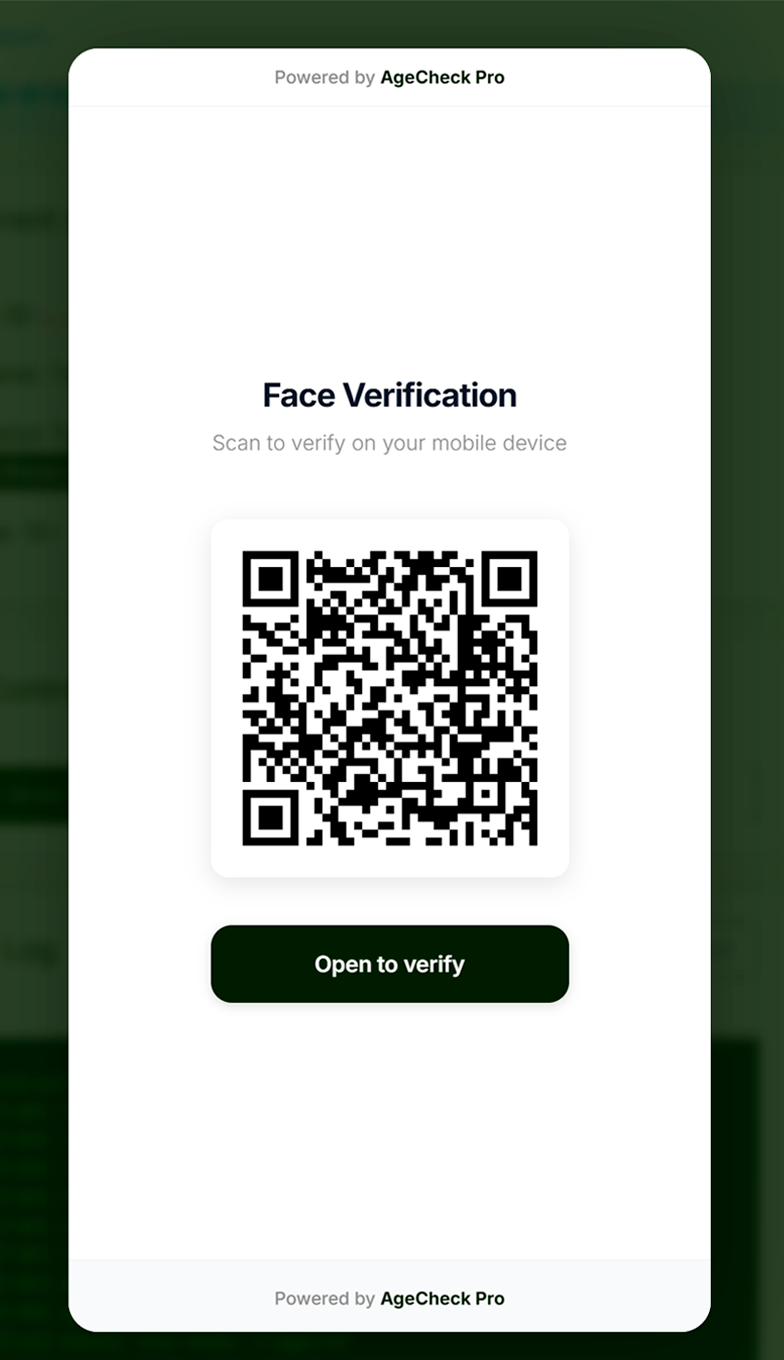
A UX pattern that bridges the gap between a desktop or bot interaction and a mobile camera-based verification. A QR code is displayed in the source environment; the user scans it with their smartphone, completes the biometric check, and the result is delivered back to the originating session via webhook.

Session Persistence

A mechanism that stores a verified status for a returning user, preventing them from repeating the age verification flow on every visit. agecheck.pro supports configurable session persistence up to 30 days via a signed, tamper-proof cookie balancing security with user experience.

WordPress Age Verification

Integration of an age gate directly into a WordPress site using a plugin or a single JavaScript tag placed in the theme header. WordPress age verification supports WooCommerce checkout flows, content-restricted pages, and per-product age gating without modifying the theme's PHP templates.

WooCommerce Age Gate

A WooCommerce-specific age verification trigger that fires during checkout when a cart contains age-restricted products alcohol, tobacco, adult content, or regulated items. The verification result is stored against the order ID and included in the audit log for compliance record-keeping.

Zero Downtime Age Verification API

A high-availability API design that maintains service continuity through rolling deployments, multi-region redundancy, and automatic failover. Zero downtime infrastructure is essential for platforms where a verification outage would block users from completing purchases or accessing time-sensitive content.

Real-Time Age Verification

Verification delivered within a single user interaction typically under 3 seconds for document checks and under 1.5 seconds for facial age estimation. Real-time processing via optimized AI inference pipelines on GCP and AWS ensures the verification step does not become a bottleneck in the user journey.

Cross-Platform Age Check

Age verification that delivers a consistent experience across web browsers, native iOS and Android apps, desktop clients, and third-party platforms such as Telegram and Discord. Cross-platform consistency is achieved by centralizing the verification logic in a single API rather than maintaining separate implementations per environment.
Industry Niches

Age assurance across
every regulated sector.

Age Verification for Alcohol E-Commerce

Regulatory requirement for online alcohol retailers to verify purchaser age at checkout or upon delivery. Document-AI integrated at the WooCommerce or Shopify checkout fulfills mandatory age gate obligations under the Licensing Act in the UK and equivalent state laws in the US.

Age Verification for Tobacco and Vape Sites

Legal obligation for online vape and tobacco retailers to prevent the sale of nicotine products to minors. Facial age estimation provides a frictionless first-layer check; document verification is triggered for edge cases near the age threshold to minimize false negatives.

Age Verification for Cannabis Delivery

Compliance requirement for licensed cannabis delivery services in legalized US states and Canadian provinces to verify customer age before dispatching an order. Verification must be completed at order placement Document AI integrated into the ordering flow satisfies state-level regulatory requirements.

Age Verification for Online Gambling

A mandatory KYC requirement for licensed gambling operators to verify that all players meet the minimum legal gambling age before first deposit. Verify-AI combining Document-AI and Face Matching provides the full audit trail required by gambling commissions in the UK, Malta, Gibraltar, and other jurisdictions.

Age Verification for Loot Boxes

Several EU member states and Asian regulators have classified in-game loot boxes as gambling, requiring platforms to verify player age before purchase. Age verification for loot boxes typically uses Face-AI for minimum friction, escalating to Document-AI for players near the age boundary.

Esports Tournament Age Check

Verification that a player meets the minimum age requirement typically 13, 16, or 18 depending on tournament rules and prize money thresholds before registering for a competitive esports event. Document-AI or Verify-AI provides the level of assurance required by major tournament organizers and sponsors.

Dating App Age Assurance

Age verification for online dating platforms to comply with child protection regulations and prevent minors from accessing adult content or matchmaking services. Face-AI delivers a frictionless onboarding experience while meeting Ofcom and DSA requirements for user age assurance on social platforms.

Age Verification for Delivery Services

Integration of age verification into last-mile delivery platforms food delivery apps, alcohol delivery services, and pharmacy delivery to confirm recipient age at the point of handoff. QR handoff age verification is the ideal pattern for courier-app integration where the delivery driver captures proof of age on their mobile device.

E-Pharmacy Age Gate

Age and identity verification for online pharmacies dispensing age-restricted medications. E-pharmacy regulation in most markets requires both age confirmation and identity proofing to ensure prescriptions are fulfilled only to the correct verified individual.

Subscription Box Age Verification

Recurring age verification for subscription services delivering age-restricted products wine clubs, cigar subscriptions, and vape kits. Verification is triggered at signup and periodically re-confirmed to maintain a valid consent record across the subscription lifecycle.

Scalable Age Check for Marketplaces

Age verification designed for high-volume marketplace environments where hundreds of individual merchants sell age-restricted items through a single platform. API-level integration allows the marketplace to apply verification rules per product category without seller-specific customization.

Legal Age Verification for Adult Content Platforms

High-assurance age verification required by platforms distributing explicit content under the UK Online Safety Act, EU Digital Services Act, and various US state statutes. The legal standard requires age verification methods that cannot be easily circumvented, making document-based and biometric methods the only compliant options in many jurisdictions.
Emerging Technologies

The next frontier
of identity assurance.

Blockchain Identity Verification

The use of distributed ledger technology to store and share verified identity credentials in a tamper-proof, decentralized format. Blockchain identity enables users to present a verified age credential across multiple platforms without repeating the underlying biometric or document check each time.

Wallet-Based Age Assurance

A model in which a user's verified age credential is stored in a digital identity wallet such as the EU Digital Identity Wallet under eIDAS 2.0 and presented to requesting platforms via a selective disclosure protocol. Wallet-based assurance gives users control over which attributes they share and with whom.

ZKP Age Proof (Zero-Knowledge Proof)

A cryptographic method that proves a statement "this user is over 18" without revealing the underlying data that supports it (the actual date of birth). ZKP age proofs are central to privacy-preserving compliance in Web3 environments, where on-chain activity must not be linkable to a real-world identity.

SBT for Age Verification (Soulbound Tokens)

Non-transferable blockchain tokens that represent a verified attribute such as age eligibility permanently bound to a specific wallet address. SBTs allow a user to prove compliance once and carry that proof into any participating dApp without re-verifying, while making the credential non-sellable and non-transferable.

Metaverse Age Gate

Age verification at the entry point of virtual reality or augmented reality environments that host age-restricted content. Metaverse age gates must account for the absence of a traditional browser, making QR handoff and wallet-based credential presentation the primary viable integration patterns.

Digital Identity Wallet for Age

A mobile application that stores verified identity credentials including an age attribute issued by a trusted authority such as a government or accredited identity provider. Under eIDAS 2.0, EU member states are required to offer citizens a digital identity wallet by 2026, creating a universal standard for cross-border age assurance.

Telegram Age Verification Bot

A bot integration that triggers an age verification flow when a user joins a Telegram channel or group. Using external sessions and QR handoff, the bot directs the user to complete biometric or document verification on their mobile device and only grants channel access once the webhook confirms a successful result.

Discord Age Gate Bot

A Discord bot that enforces age verification before assigning roles that grant access to age-restricted server channels. GDPR and COPPA compliant configurations ensure that no PII is stored by the bot only a verified/unverified status is recorded against the Discord user ID.

Social Media Age Assurance

The technically and legally preferred term over "age verification" for the range of methods social media platforms use to establish user age. Regulators in the UK, EU, and US are increasingly mandating social media age assurance as part of online safety legislation targeting platforms with minor user bases.

Web3 KYC Alternative

Decentralized identity protocols DIDs, VCs, and SBTs that perform the compliance function of traditional KYC without routing sensitive personal data through a centralized third party. Web3 KYC alternatives allow DeFi platforms, DAOs, and NFT marketplaces to meet regulatory requirements while preserving user pseudonymity.

Global Age Verification Compliance Map

A reference framework documenting the age verification requirements per country and sector which regulations apply, what methods are mandated, and what the penalties for non-compliance are. A compliance map is an essential planning tool for platforms expanding across jurisdictions with divergent legal requirements.

Decentralized Age Check

An age verification model in which the verification credential is held by the user rather than a central provider, and presented on demand via cryptographic proof. Decentralized age checks remove the single point of failure associated with centralized identity databases and reduce compliance exposure for the relying party.
UX & Growth

Verification that converts.
Friction that does not.

Seamless Age Verification UX

A verification experience designed to feel like a natural part of the onboarding flow rather than an obstacle. Seamless UX combines passive liveness, auto-capture document scanning, and pre-filled session data to reduce time-to-verified to under 10 seconds for the majority of users.

Mobile-First Age Assurance

A verification design philosophy that optimizes the selfie capture and document scanning flows for smartphone screens, camera hardware, and touch interaction patterns before considering desktop. Given that over 70% of age verifications are initiated on mobile devices, mobile-first design directly impacts global pass rates.

No-Click Age Verification

A fully passive age estimation flow in which the user performs no explicit action the verification runs automatically from a single camera frame captured during page load. No-click verification achieves the highest possible conversion rates by eliminating the psychological barrier of an explicit verification consent step.

Instant Age Estimation

Sub-second facial age estimation delivered via an optimized inference pipeline running close to the user's geographic region. Instant results are critical for high-frequency verification contexts live streaming entry, physical access control, or real-time gating of dynamic content feeds.

Conversion-Rate-Optimized Age Check

Age verification flows designed with A/B tested UI patterns, progressive disclosure, and fallback method selection to maximize the percentage of users who successfully complete verification. CRO age checks treat verification as a funnel step with measurable drop-off rates and continuously optimized conversion paths.

Frictionless Age Gate Integration

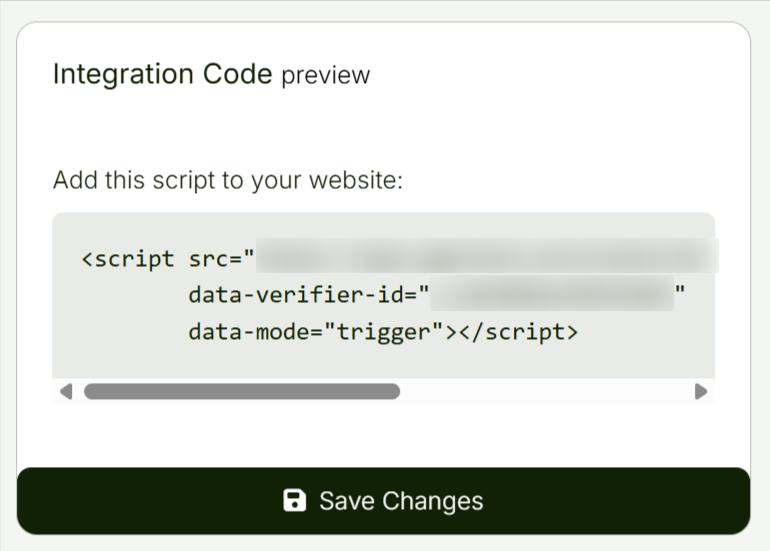
The developer experience of embedding age verification with minimal configuration effort a single script tag, a pre-built UI component, and a webhook endpoint. Frictionless integration is the most-cited requirement from engineering teams evaluating age verification vendors, directly affecting time-to-market.

User-Friendly Age Gate

An age gate designed with clear instructions, accessible UI components, multilingual support, and a helpful error state when verification fails. A user-friendly age gate minimizes support ticket volume and reduces user abandonment caused by confusion during the verification process.

Non-Intrusive Age Wall

An age verification experience that intercepts access without disrupting the visual design or content presentation of the host platform. Non-intrusive age walls use modal overlays, inline prompts, or background passive checks rather than full-page interstitials that break the user journey.
Get started

Ready to verify age
the right way?

No credit card required. Live in 5 minutes.