Full identity verification.
KYC/AML compliance.

Triple-layer verification combining facial biometrics, document authentication, and live face matching. Verify-AI confirms the person presenting an ID is the legitimate document holder

Complete KYC in
four phases.

1
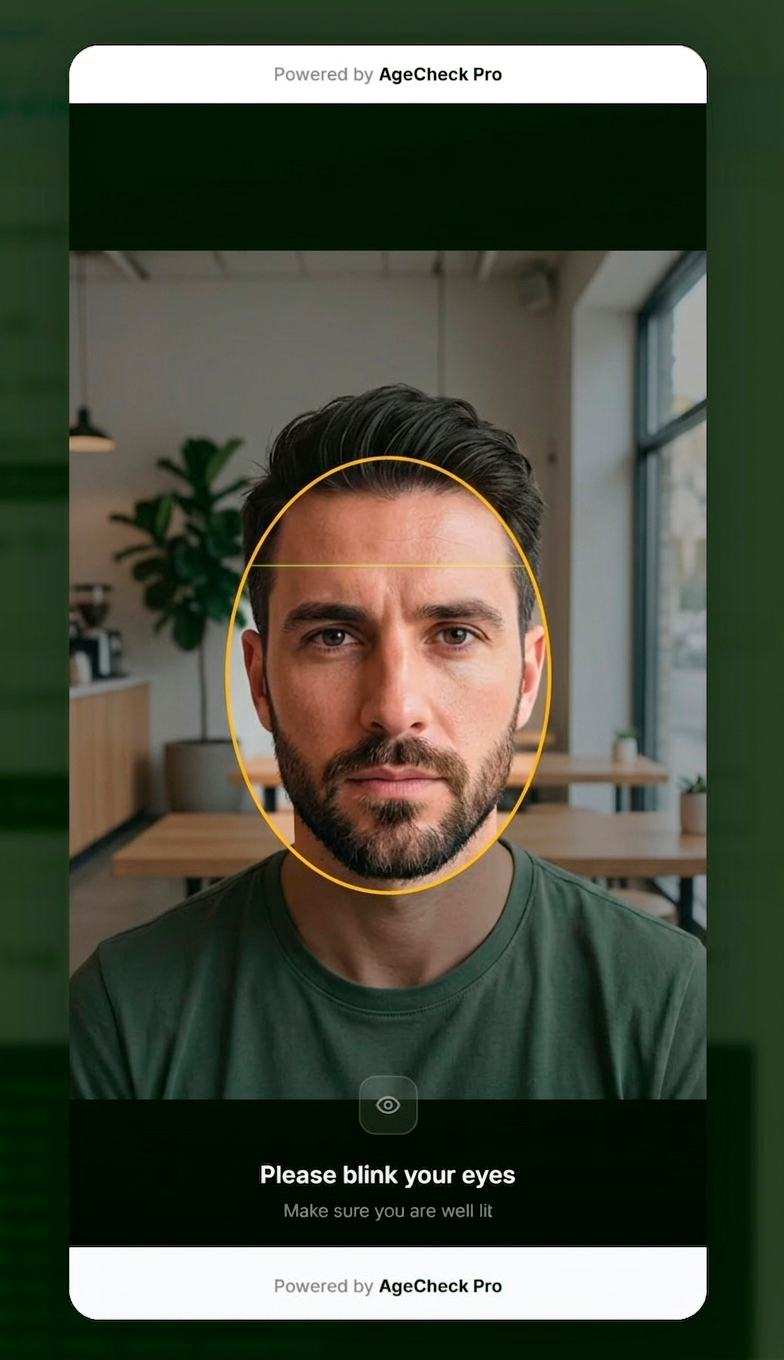
Liveness verification
User completes active liveness challenges — smile, turn head, blink. AI estimates age range from facial geometry.
2
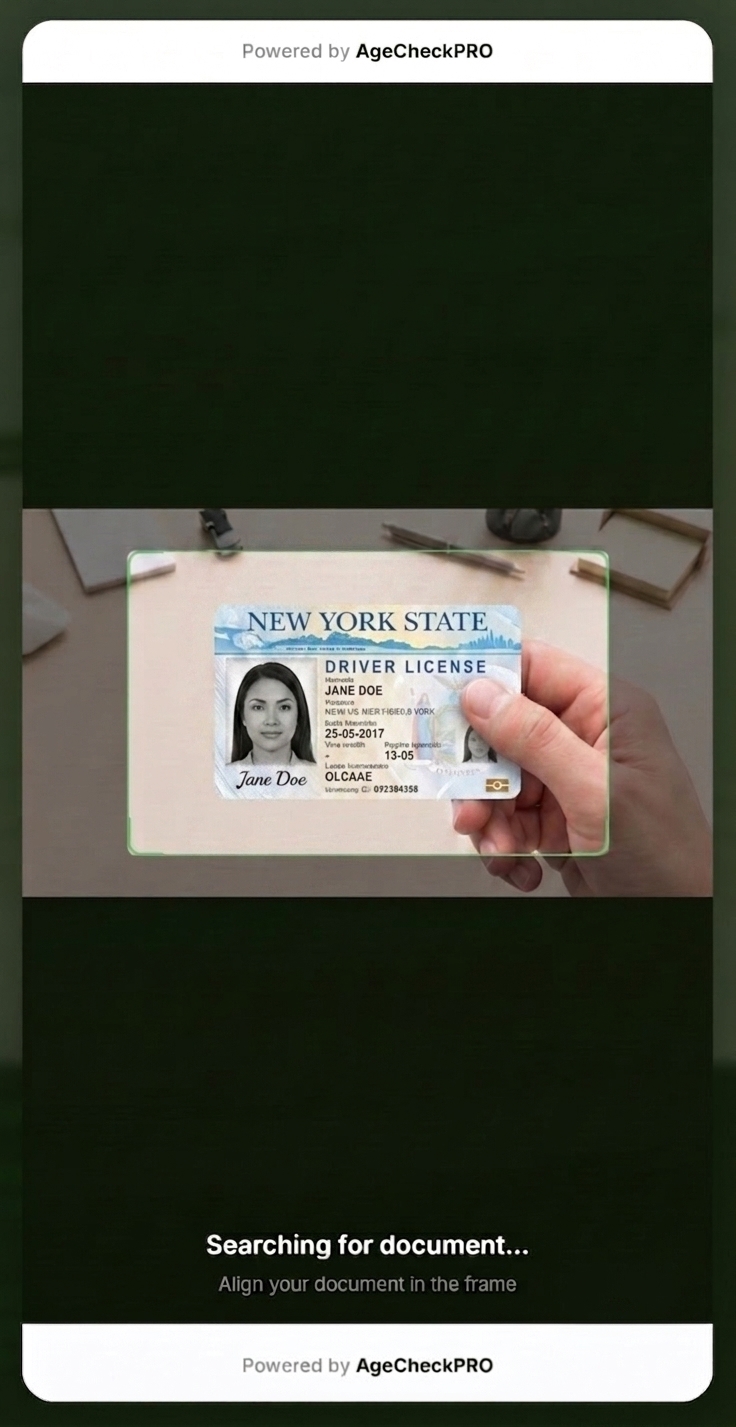
Document capture & OCR
Photograph government-issued ID. AI extracts DOB, name, document number with authenticity scoring.
3
Biometric face matching
Live face from liveness check matched against document photo. ≥90% similarity required to pass.
4
Cross-validation & audit
Facial age estimate vs document DOB verified (<10yr difference). Immutable KYC audit trail created.

Why Verify-AI stops
identity fraud.

Single-layer verification methods leave gaps attackers exploit. Verify-AI combines three independent verification technologies to create a complete identity assurance system that satisfies regulatory requirements while blocking fraudulent attempts.

Layer 1: Biometric face matching
Advanced facial recognition compares the live face captured during liveness challenges against the photograph on the submitted document. The system analyzes dozens of facial landmarks, measuring geometric distances between eyes, nose, mouth, and jawline. A similarity score is calculated — only matches above 90% threshold pass verification. This prevents someone from using a stolen or borrowed ID.
Layer 2: Document authentication
AI-powered OCR extracts structured data from government-issued documents: name, date of birth, document number, expiration date, issuing authority. Supports driver's licenses, passports, national ID cards across 150+ countries. Document authenticity is scored 0-100% based on security features, font consistency, template matching, and tamper detection algorithms that identify photo swaps, text edits, and digitally altered documents.
Layer 3: Active liveness detection
Interactive challenges prove the person is physically present and not a photograph, video, deepfake, or 3D mask. Head rotation analyzed in 3D space with motion vector tracking. Smile detection measures facial muscle patterns. Texture analysis identifies screen reflections and printed photo characteristics. Temporal consistency validation across video frames catches morphing attacks and pre-recorded video playback attempts.
Cross-validation logic
The facial age estimation from liveness check is compared against the calculated age from document DOB. If the difference exceeds 10 years, the verification is flagged for manual review. This cross-check catches scenarios where someone uses a family member's ID or where the document photo has been replaced. The age correlation acts as a sanity check on the biometric match.
Tamper detection scoring
Machine learning models trained on millions of genuine and fraudulent documents score tampering likelihood from 0-100%. Detects photo substitution by analyzing edge artifacts around portrait areas. Identifies text manipulation through font inconsistencies and character spacing anomalies. Recognizes expired documents, voided credentials, and template mismatches. High tamper scores trigger automatic rejection or route to manual review queues.
Anti-impersonation guarantee
The combination of live face capture and biometric matching to document photo creates a chain of custody proving the person completing verification owns the identity claimed. This prevents the most common form of identity fraud: using someone else's legitimate documents. Critical for platforms with regulatory obligations to verify not just age but actual identity of account holders.

Biometric face matching
explained simply.

Facial recognition for identity verification works differently than facial recognition for unlocking your phone. Phone unlock systems create a biometric template stored on your device and compare new images against that template. Verify-AI performs a one-time comparison between two images without creating persistent templates.

During verification, the system captures a live face from the liveness challenges and extracts a face from the uploaded ID document photo. Both faces are converted into numerical representations called facial embeddings — arrays of numbers describing the geometric relationships between facial features.

The embeddings are compared using cosine similarity algorithms that calculate the angular distance between the two vectors. A similarity score from 0-100% is produced. Scores above 90% indicate the same person with high confidence. Scores below 70% suggest different individuals. The 70-90% range triggers manual review.

Importantly, both the live image and document photo are deleted immediately after comparison. Only the similarity score and verification outcome are stored in audit logs. This ephemeral processing architecture means Verify-AI doesn't maintain a biometric database of faces — each verification is stateless and privacy-preserving.

Fraud detection signals
Photo substitution · Edge artifacts detection
Visual
Text tampering · Font inconsistency analysis
OCR
Expired documents · Date validation
Temporal
Template mismatch · Format verification
Structural
Screen detection · Moire pattern analysis
Anti-spoof
Security features · Hologram/watermark check
Advanced

Document authentication
stops fake IDs.

Document verification alone isn't enough — attackers can create convincing fake IDs or alter legitimate documents. Verify-AI's document authentication layer analyzes dozens of fraud signals to detect tampering, forgery, and sophisticated document manipulation.

Photo substitution is detected by analyzing the edges around portrait areas. Genuine ID photos are printed or embedded during card production with smooth, consistent edges. Swapped photos show telltale artifacts: color mismatches, edge pixelation, or subtle shadows that don't match the original lighting. The AI has seen millions of genuine documents and recognizes these anomalies instantly.

Text manipulation is caught through font analysis. Government IDs use specific fonts, character spacing, and text alignment. When someone edits a date of birth or name using photo editing software, micro-inconsistencies appear: slight font weight differences, imperfect kerning, color variations. The system compares extracted text against known templates for each document type and flags deviations.

Expired documents are automatically rejected through date validation. Template matching verifies the submitted document matches the expected format for that document type and issuing region — a California driver's license from 2023 should match the known California DMV template for that year. Screen detection identifies when someone photographs a digital image of an ID rather than the physical card.

All fraud signals are weighted and combined into a 0-100% authenticity score. Documents scoring below configurable thresholds are automatically rejected. Mid-range scores can route to manual review queues where human operators examine flagged documents with fraud detection annotations highlighting suspicious areas.

KYC/AML audit trail
meets regulatory standards.

Verify-AI creates immutable verification records satisfying Know Your Customer (KYC) and Anti-Money Laundering (AML) requirements for financial services, online gambling, cryptocurrency exchanges, and other regulated industries.

Complete audit logs
Every verification creates a timestamped, immutable record containing: verification method used, all three layer outcomes (liveness pass/fail, document authenticity score, biometric match score), extracted PII (name, DOB, document number), fraud detection flags, and final verification decision. Records are retained for the legally required period in your jurisdiction with cryptographic integrity protection preventing tampering.
Identity correlation
Verify-AI links each verification to a unique user identifier in your system, creating a traceable chain from account creation through verification to ongoing platform activity. This correlation proves you've verified the identity of users engaging in regulated transactions — critical for regulatory audits demonstrating compliance with customer identification requirements.
Sanctions screening integration
Extracted identity data (full name, date of birth, document number) can be passed to sanctions screening APIs to check against OFAC, UN, EU, and other watchlists. This additional layer helps platforms comply with sanctions regulations by flagging individuals on restricted person lists before granting account access. Screening results are appended to the verification audit trail.
Re-verification workflows
Configure automatic re-verification triggers: periodic intervals (annual KYC refresh), high-value transaction thresholds, account behavior changes, or risk score increases. Re-verification uses the same three-layer process, creating a new audit record that proves continued identity assurance over the customer lifecycle. Essential for ongoing compliance in regulated industries.
Regulatory reporting
Export verification data in formats required by regulators: CSV for bulk analysis, JSON for system integration, PDF reports for individual record review. Filter exports by date range, verification outcome, fraud score thresholds, or user cohorts. Pre-built report templates for common regulatory requests accelerate audit responses and demonstrate compliance program effectiveness.
GDPR & privacy compliance
Despite processing identity documents, Verify-AI maintains privacy-by-design principles. Facial images and document photos are ephemeral — deleted immediately after analysis. Only structured data (name, DOB, scores) persists in audit logs. Right-to-erasure requests can delete user records when legal retention periods expire. Data processing agreements available to support GDPR Article 28 controller-processor relationships.

Explore other
verification methods.

Verify-AI delivers maximum identity assurance with full KYC compliance, but not all platforms require this level of verification. Compare all four methods to balance regulatory requirements with user experience optimization.

Full age Identity Match
Current Method
Complete identity verification combining facial biometrics, document authentication, and live face-to-photo matching. Three security layers prevent impersonation and fraud. 40-60% completion rate. Mandatory for online gambling, cryptocurrency platforms, fintech applications, and any service requiring KYC/AML regulatory compliance.
Exact Date of Birth
ID Verification
Precise date of birth extraction via AI-powered OCR from driver's licenses, passports, and national IDs across 150+ document types. Authenticity scoring detects tampering and fraud. 60-75% completion rate. Essential for alcohol/tobacco delivery, age-restricted e-commerce, and platforms requiring exact DOB for regulatory compliance. Learn more →
Age estimation
Biometric Age Estimation
Biometric age estimation through facial geometry analysis with active liveness detection. Users complete smile and head-turn challenges in 10 seconds. 85-90% completion rate without ID requirements. Best for gaming platforms, streaming services, and content sites prioritizing user experience over exact birth dates. Learn more →
Self-Consent button
Instant Access
Simple checkbox age affirmation without cameras or documents. Single-click attestation creates legal record while maximizing accessibility. 98% completion rate with zero technical barriers. Optimal for editorial content, information portals, blogs, and platforms where reasonable age controls satisfy legal requirements. Learn more →

Confused about age verification? Our Regulations Map analyzes your compliance needs, industry, and user base to recommend the perfect solution.

Regulations Map
≥90%
Biometric similarity threshold

The minimum similarity score required between the live face captured during verification and the document photo. Configurable from 70-95% to balance security requirements with false rejection rates based on your risk tolerance.

Verification layers Face + Document + Biometric matching
Document support 150+ countries · All major ID types
Age cross-validation <10 year difference required
Anti-spoofing Active liveness detection
Compliance KYC · AML · GDPR · FATF
Verification time 60-90 seconds complete flow

Full KYC identity verification.
Regulatory compliance.

Triple-layer verification with biometric face matching, document authentication, and liveness detection