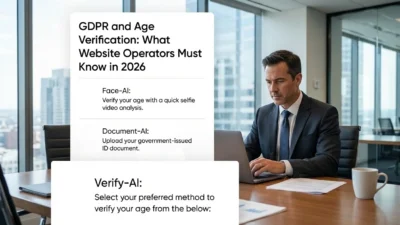
Age verification regulations in 2026 span every major digital economy, and the pace of new legislation has accelerated significantly since 2023. For any operator running an age-restricted platform whether adult content, gambling, alcohol e-commerce, or social media understanding the current global regulatory landscape is no longer optional.
Europe the DSA and national implementations
The EU’s Digital Services Act (DSA) is now fully in force for all platforms. Article 28 of the DSA requires “very large online platforms” (VLOPs) to implement robust age verification systems, but national regulators have extended similar requirements to smaller platforms in several member states.
- France: ARCOM (previously CSA) now enforces mandatory age verification for pornographic content under the SREN law, with fines up to €250,000 per violation plus daily penalties.
- Germany: The JMStV (Youth Media Protection State Treaty) requires effective age verification for all platforms with youth-harmful content. The KJM regulates enforcement.
- Netherlands: The ACM and Mediaregelgeving impose age verification obligations for adult content accessible to Dutch users.
- UK: The Online Safety Act’s age verification provisions are now fully active, with Ofcom enforcing compliance for services accessible from the UK.
United States state-by-state patchwork
There is no federal age verification law in the US, but the state-level patchwork has grown to cover a majority of the population:
| State | Law | Platforms Covered | Min. Age | Status |
|---|---|---|---|---|
| Louisiana | HB 142 | Adult content | 18 | Active |
| Texas | HB 1181 | Adult content | 18 | Active (post-Free Speech Coalition v. Paxton) |
| Virginia | HB 2331 | Adult content | 18 | Active |
| Utah | HB 311 + SB 287 | Adult content + Social media | 18 / 16 | Active |
| Florida | HB 3 | Social media | 14 (account ban) | Active 2026 |
| California | AB 2089 (AADC) | Online services likely accessed by minors | 18 | Active |
Asia-Pacific emerging requirements
Age verification mandates are emerging across the Asia-Pacific region:
- Australia: The Online Safety Act requires age verification for Class 1 content (equivalent to Refused Classification). The eSafety Commissioner is currently in consultation on technical standards.
- Singapore: The Online Safety (Miscellaneous Amendments) Act requires designated services to implement age assurance measures.
- India: The IT Rules 2021 (as amended) require significant social media intermediaries to implement age verification for minors under 13.
What operators must do now
The regulatory direction is unambiguous: age verification is mandatory, and self-declaration checkboxes do not satisfy any modern regulatory requirement. Operators should:
- Audit which jurisdictions their users come from and identify applicable laws.
- Assess whether their current age gate meets the “effective” or “robust” standard required.
- Implement a compliant, privacy-preserving age verification system before enforcement action occurs.
- Document their compliance posture with audit logs and a data processing record.
agecheck.pro supports compliance across all major jurisdictions with configurable verification methods, geo-targeting, and comprehensive audit logging. Review the compliance features contact to sales.