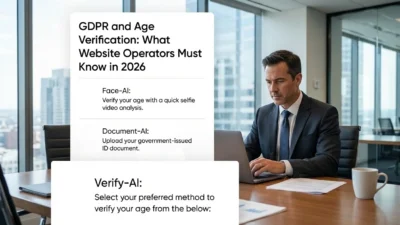
There is a quiet contradiction sitting at the center of most age verification deployments. The methods that produce the highest confidence document scans, facial age estimation, biometric signals are also the methods that create the most significant legal exposure under data protection law. Collecting that data and holding onto it turns a compliance tool into a compliance liability.
Under GDPR, biometric data used to identify a natural person falls into the special categories under Article 9, carrying strict requirements around explicit consent, data minimization, and purpose limitation. Under COPPA, any personal information collected from a child under 13 without verifiable parental consent triggers civil penalties that accumulate fast. The same pattern repeats across the UK, Australia, and Canada with local variations on the same theme.
The goal is to know a user is old enough not to know who they are. Those are two completely separate problems, and conflating them is where most platforms create avoidable legal risk.
The resolution is architectural. Privacy-first age verification processes the signals needed to make an age determination and immediately discards the inputs. What remains is a single boolean outcome verified or not with no biometric template, no document image, and no personal profile built as a side effect of the check. AgeCheckPRO was designed around this principle from day one.
The Global Regulatory Landscape in 2025
Any platform with an international user base has to navigate overlapping and sometimes contradictory obligations. The cards below summarize what compliance teams need to know in each major market and how those requirements translate into concrete technical decisions for your age gate.
COPPA prohibits collecting personal data from children under 13 without verifiable parental consent. The Kids Online Safety Act extends duties of care to platforms accessible to users under 16, requiring robust age detection before content is served.
GDPR classifies biometric data as a special category requiring explicit, specific consent and strict data minimization. The Digital Services Act mandates systemic risk assessments for large platforms accessible to minors across all 27 member states.
The Online Safety Act requires platforms hosting pornographic content to implement age verification that regulators consider highly effective. The ICO’s Age Appropriate Design Code demands age-appropriate privacy defaults for any service children are likely to access.
Australia’s eSafety Commissioner has issued binding codes requiring age assurance for class 1A and 1B content. Social platforms now face specific obligations to prevent users under 16 from creating accounts without verified age controls.
Canada’s Online Harms Act introduces age-appropriate design obligations and mandatory age verification for adult content platforms. Platforms operating in Quebec face additional requirements under Law 25, which mirrors several GDPR principles.
Brazil (LGPD), Germany (JMStV), France (ARCOM), and India (DPDP Act) are each implementing national age verification frameworks. Most are modeled on GDPR principles, making a privacy-first architecture the strongest long-term compliance position across all markets simultaneously.
How Privacy-First Age Verification Works
The technical architecture of a zero-data-retention age verification system is fundamentally different from traditional identity verification, which stores personal data and queries it on repeat. In the privacy-first model, verification signals are processed in memory the age determination is made, the inputs are discarded, and only the outcome passes through to your platform.
This architecture directly satisfies the GDPR principles of data minimization (Article 5(1)(c)) and purpose limitation (Article 5(1)(b)). Personal data must be adequate, relevant, and limited to what is necessary. A facial biometric retained as a byproduct of an age gate fails that standard. A boolean token does not.
For returning users, AgeCheckPRO issues a zero-knowledge age credential a cryptographically signed token that your platform validates locally without contacting the verification service again. The user’s age threshold is confirmed; their identity stays private; and you can demonstrate compliance without maintaining a data trail that creates future exposure.
Risk Comparison: Biometric Storage vs. Zero Retention
Not every age verification solution carries the same regulatory risk profile. The chart below maps relative compliance exposure across key risk dimensions comparing traditional approaches that retain biometric data against a zero-retention architecture.
GDPR & COPPA Compliance Verification Matrix
When evaluating any age gate solution, your legal and engineering teams should work through each of the following requirements. The table maps each regulatory obligation to its source and compares traditional KYC-style verification against AgeCheckPRO zero-retention model.
| Requirement | Regulation | Traditional KYC | AgeCheckPRO |
|---|---|---|---|
| No biometric data stored post-verification | GDPR Art. 9, BIPA | Often retained | Zero retention |
| Data minimization by design | GDPR Art. 25 | Full ID copied | Boolean token only |
| No personal profile created | COPPA, DSA, KOSA | Identity linkage created | Anonymous session |
| Audit trail without PII | GDPR Art. 5(2) | Logs contain personal data | Anonymized event log |
| Parental consent workflow | COPPA, KOSA, DSA | Manual, not scalable | Automated verified consent |
| Cross-border data adequacy | GDPR Ch. V, UK GDPR | International transfer risk | Regional processing |
| Conversion-optimized flow | Business requirement | 60–70% typical completion | Above 94% completion |
Industries Where the Regulatory Risk Is Highest
The enforcement pressure is not distributed evenly. Some industries face immediate action; others are a regulatory cycle or two behind. Here is where compliance teams should be concentrating effort in 2025.
Adult Content Platforms
The UK Online Safety Act and Australia’s Online Safety Act both impose strict obligations on sites that host explicit material. Failure to implement age assurance that regulators consider highly effective exposes operators to platform bans, payment processor termination, and in some jurisdictions, criminal liability. AgeCheckPRO integrates via API directly into content gates, with verification completing in under 20 seconds and zero biometric data retained on your servers.
Online Gambling and iGaming
The UK Gambling Commission, Malta Gaming Authority, and US state gaming regulators all require documented age verification processes. The less obvious challenge is satisfying those requirements without creating PII-linked records for users who browse but never convert a pattern that generates GDPR exposure when data is held without a clear legal basis for the retention period.
Social Media and Creator Platforms
Under KOSA and the EU’s Digital Services Act, social networks and creator monetization platforms must implement age-appropriate design from the moment a user arrives, not after account creation. This includes accurate identification of users likely to be minors, appropriate content filtering, and restrictions on behavioral advertising targeting anyone under 18.
E-Commerce: Alcohol, Tobacco, and Vaping
Online retailers selling age-restricted goods face both regulatory liability and payment processor risk the moment a minor completes a purchase. A lightweight, API-driven age gate at checkout addresses both without the abandonment that comes with heavier identity verification flows satisfying US state ABC requirements, the UK Licensing Act, and equivalent EU member state regulations without materially affecting the checkout experience.
Healthcare and Pharmaceutical Services
Telemedicine platforms, prescription information services, and digital mental health apps increasingly need to verify user age before exposing clinical content particularly under COPPA, the EU’s emerging framework governing youth access to health-related digital services, and state-level laws like California’s Age-Appropriate Design Code.
The Enforcement Reality
Age verification enforcement is no longer a distant prospect. Ofcom issued its first formal enforcement notices under the Online Safety Act in 2024. The FTC has brought COPPA enforcement actions against major platforms resulting in combined settlements exceeding $500 million. Australia’s eSafety Commissioner has levied landmark fines against platforms that could not demonstrate adequate age assurance controls.
Beyond direct regulatory fines, the secondary costs of non-compliance have grown considerably: app store removal, termination by payment processors who publish their own age verification requirements for adult content merchants, class-action litigation driven by state privacy laws in the US, and advertiser-relationship damage that compounds over time.
The cost-benefit calculation is straightforward for most platforms. Contact AgeCheckPRO compliance team to get a clear picture of the obligations that apply to your platform, your markets, and your user base along with a deployment estimate that fits your existing stack.
Zero Biometric Retention.
AgeCheckPRO gives you GDPR-ready, COPPA-compliant age verification that stores nothing, converts above 94%, and satisfies regulators across 60+ markets.